
8 Questions to Ask Before You Choose a Fabricator
You've got quotes. Now comes the part nobody tells you about — figuring out which fabricator will actually deliver what they promised. Here's what to ask, what to look for, and what the answers should sound like.
Getting quotes is the easy part. Evaluating them is harder.
Per-square-foot numbers don't tell you who's showing up at your house, what equipment they're using, or how your project will actually be handled from measurement to install. The questions below are the ones that separate a great outcome from a costly regret — and they're worth asking before you sign anything.
Who actually comes to my home to do the install?
This is the most important question on this list, and the one most homeowners never think to ask. Many fabricators — including some well-reviewed ones — sub-contract the installation to crews they don't directly manage. Your countertops were fabricated in one shop by one set of hands. They arrive at your house with a completely different crew that the fabricator may not even know personally.
Why does that matter? Because installation quality is determined by the crew on the day — the glues they choose, the seam-setting technique they use, how they handle the stone coming off the truck, how they manage the cutouts. Sub-contracted crews are working multiple jobs, using their own tools and supplies, and cutting corners where they can. The fabricator has limited ability to hold them to any specific standard.
A fabricator with their own installation team trains them, equips them, and has every reason to care about the outcome. When the same people who built your countertops are the ones installing them, the accountability is total.
- 🔴Red flag: "We work with trusted local installers" or any version of "our installation partners." That's a sub-contracted crew.
- 🟢Good answer: "Our own employees do every installation. The same team that fabricated your countertops is the team that installs them."
 How we handle it
GranitePro's fabrication and installation teams are our own employees.
We've built and trained our crew specifically for this work. They know our standards because we set them — and they're accountable to us, not to a staffing arrangement.
How do you measure my kitchen before fabrication?
Templating — the process of measuring your kitchen before fabrication — is where precision either happens or it doesn't. Traditional templating uses physical sticks, cardboard, or paper patterns held against your walls and traced by hand. It works most of the time. When it doesn't, you find out on installation day when a piece doesn't fit, a seam is off, or a cutout is in the wrong place.
Digital laser templating is a different category entirely. The system scans your kitchen with millimeter accuracy, capturing every angle, every out-of-square wall, every inconsistency — things a tape measure and a steady hand simply cannot detect reliably. That data feeds directly into the CNC, so what gets cut is exactly what was measured. Not close. Exactly.
There's a practical benefit for you too: because the template is digital, your existing countertops can usually stay in place until installation day. You don't live without a kitchen for a week.
- 🔴Red flag: Physical template sticks or paper patterns. Fine for simple jobs; a liability for anything with curves, unusual angles, or tight appliance clearances.
- 🟢Good answer: "We use digital laser templating. The data goes straight into our CNC. Your existing countertops stay in place until install day."
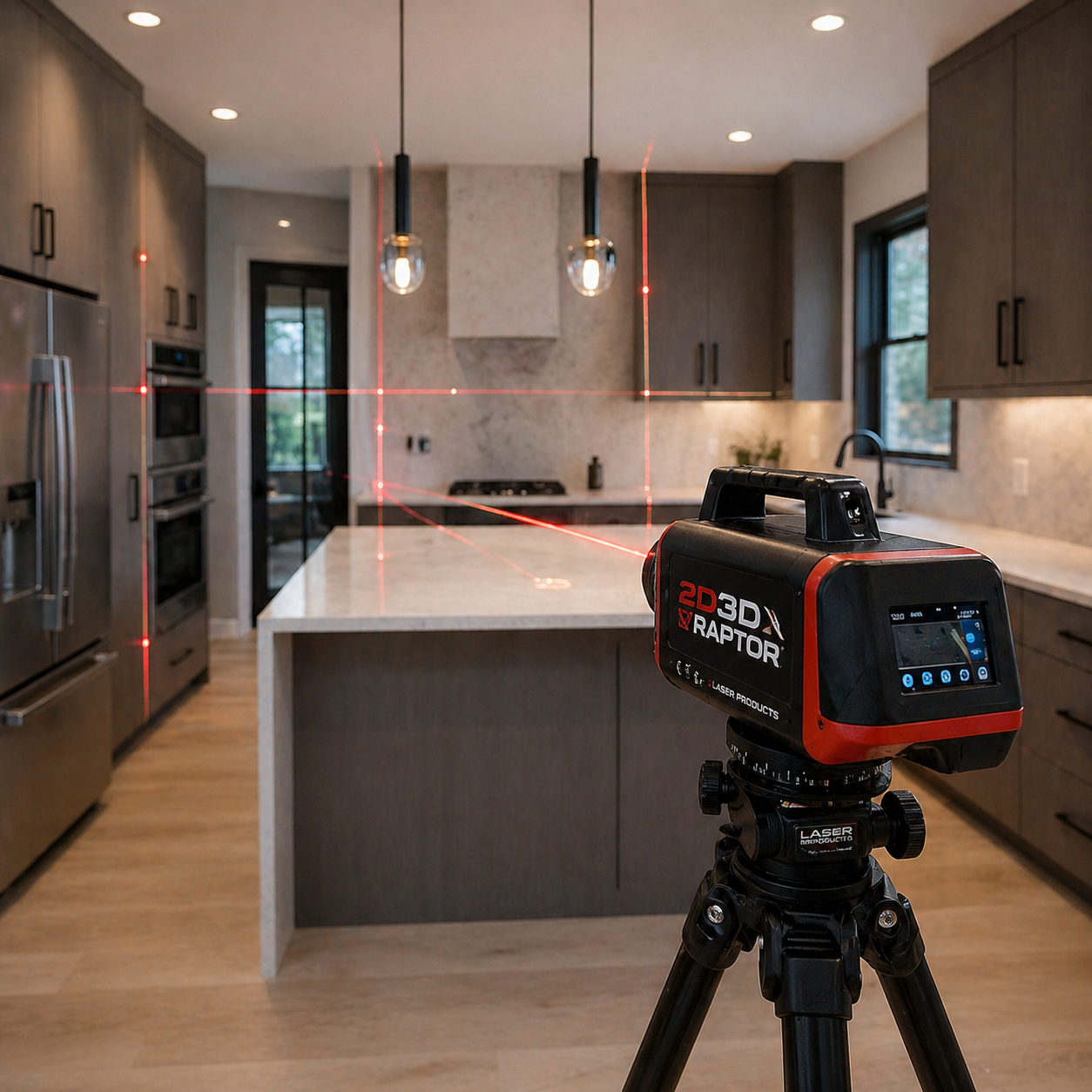 How we handle it
State-of-the-art digital laser templating on every project.
Our digital system captures your space with millimeter precision. That data drives the CNC directly — no translation errors, no "close enough" moments on installation day.
What equipment do you actually use to cut and finish my countertops?
There's a wide range of what "fabrication" actually means in this industry. A smaller shop may be running a basic wet saw and doing edge finishing by hand — which works, but introduces variability that depends entirely on who's working that day and how much time they have. A fully equipped fabrication facility runs purpose-built industrial machines where the human variable is largely removed from the equation.
The specific equipment matters more than most homeowners realize. A CNC waterjet cuts with a precision no hand-guided saw can replicate — every edge, every cutout, every radius is exactly what the digital template specified. A dedicated router system for polishing produces a consistent edge profile across the entire run, not one that tapers where the operator's hand pressure varied.
There's also a step that the best fabricators perform that most homeowners have never heard of: slab scanning. Before a single cut is made, the full slab is digitally scanned so the team can see exactly how the layout will look — where the veining falls, where the pattern lands on the island versus the perimeter, how a seam will read. It eliminates guesswork entirely. Without it, fabricators are making educated judgment calls about layout. With it, the outcome is known before fabrication begins.
- 🔴Red flag: Vague answers about "professional equipment" or "industry-standard tools." Any fabricator worth choosing should be able to name their cutting system specifically.
- 🟢Good answer: Named cutting and finishing systems, digital templating that feeds directly into the CNC, and ideally slab scanning before fabrication begins.
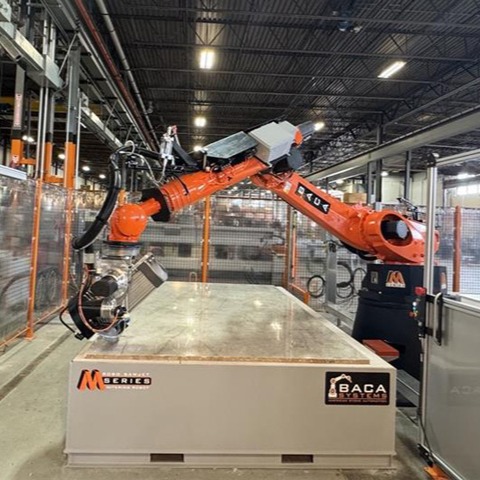 How we handle it
A full industrial fabrication system — not a shop saw.
Our Eldersburg facility runs a Baca CNC waterjet for cutting and a Northwood router system for edge polishing — two purpose-built machines that remove hand variability from the process. We also run a water recycling system, so fabrication waste water is recirculated rather than discharged.
Before any cut is made, we scan every slab. Our team sees the exact layout — where every vein and pattern lands — before fabrication begins. We can share that view with you too, so you're not guessing how your stone will look until it's already installed.
How do you set seams, and what goes into making one that hides well?
A seam that hides well is the result of several things done right at once. Get any one of them wrong and the seam becomes the most visible thing in your kitchen. Most homeowners only think about seams after they're in — which is too late to ask the question.
There are four components that determine seam quality, and a fabricator who knows what they're doing can speak to all of them:
Flow and layout of the material. Before fabrication begins, the slab needs to be planned so the seam falls where the stone's natural pattern helps it hide. A seam running through a dramatic vein reads differently than one placed at a calm, consistent part of the stone. This is a planning decision, not a cutting decision — and it happens before any machine runs.
The seam setting system. How the two pieces are held in place while the adhesive cures determines whether the seam sits perfectly flush or ends up with one side slightly raised. A professional seam setting system draws the pieces together and holds them at exactly the same height under controlled pressure. Without it, you're relying on the installer's hands and judgment in the moment.
The adhesive. For granite, an epoxy-polyester hybrid creates a commercial-grade bond and can be custom color-matched to the specific slab. For white quartz, UV-resistant adhesive is critical — standard polyesters yellow over time, turning a seam that hid well on day one into a visible brown line within a year or two. It's a cheaper option some fabricators use to protect their margin at your expense.
The treatment of the seam after it's set. Once the adhesive cures, the seam is dressed — cleaned, leveled, and finished so the surface reads consistently across the joint. This final step is where the work either comes together or falls apart, and it requires time and attention that a rushed crew won't give it.
- 🔴Red flag: Any fabricator who promises "invisible seams." No seam is invisible on natural stone — the honest standard is that a great seam hides well. Overselling this is a sign they either don't understand the material or they're telling you what you want to hear.
- 🟢Good answer: A specific seam setting system by name, custom color-matched adhesive, UV-resistant glue for white quartz, and a clear explanation of how layout planning affects where the seam falls.
 How we handle it
All four components. Every time.
We plan seam placement during slab layout — before fabrication starts. We set seams with the Gorilla Seam Setting System. We use custom color-matched epoxy-polyester hybrid adhesive for granite, and UV-resistant adhesive specifically for white quartz. And we treat and finish every seam after it's set.
The goal on every project is a seam that hides well. That outcome doesn't happen by accident — it's the result of four things done right in sequence.
How do you anchor undermount sinks, and what do you use to seal the perimeter?
Nobody thinks about sink anchoring until a sink fails. It's one of those details that's completely invisible when done right and absolutely catastrophic when done wrong — water damage, plumbing damage, and a repair bill that almost certainly exceeds whatever the cheaper method saved at install.
There are two components to a sink installation that holds long-term, and both matter:
The anchoring system. There's a wide range of methods fabricators use to hold undermount sinks in place — from engineered systems purpose-built for stone countertops to improvised solutions that vary by crew and job. The right question isn't "do you anchor the sink" — it's "with what." A fabricator using a professional-grade anchoring system will be able to name it without hesitation.
The perimeter seal. This is where most fabricators quietly cut corners. Pure silicone applied around the entire perimeter creates a flexible, waterproof bond that holds up to the heat, moisture, and movement a kitchen sink sees over years of use. Many fabricators use caulk instead — it's cheaper, it looks the same on day one, and it degrades significantly faster. Caulk shrinks, cracks, and loses its bond over time. Silicone doesn't.
The anchoring system and the perimeter seal work together. A strong anchor with a degraded perimeter seal still lets water migrate. A proper silicone seal with an inadequate anchor still lets the sink move. You need both done right for a sink installation that won't give you problems.
- 🔴Red flag: Vague answers about "heavy-duty adhesive" or "professional caulk." Caulk around the perimeter is a cost-saving shortcut — ask specifically whether it's silicone or caulk.
- 🟢Good answer: A named professional anchoring system and pure silicone — not caulk — applied around the full perimeter of the sink.
 ❌ Typical sub approach
 ✓ GranitePro standard
Sink-It anchoring system. Pure silicone perimeter seal. Both, every time.
We use the Sink-It heavy-duty anchoring system on every undermount installation — a professional solution engineered specifically for stone countertops. The full perimeter is sealed with pure silicone, not caulk. More expensive than the alternative. The combination all but guarantees the sink won't fail.
How do you transport countertops to the job site?
Stone countertops are heavy, brittle under stress, and finished. A chip or crack in transport is your problem if the fabricator isn't set up to prevent it — and depending on how they handle it, it can mean delayed installation, a visible repair, or starting the whole material order over.
The difference in how fabricators approach this is significant. Some use purpose-built enclosed transport vehicles, properly supported A-frames, and padding specifically engineered for stone slabs. Others load countertops into whatever truck is available — open flatbeds, rental vehicles with improvised support, or vehicles shared with other cargo. The stone is exposed to weather, road debris, and vibration the whole way to your home.
A fabricator who takes the finished product seriously takes transport seriously. It's a direct reflection of how much they value the work once it leaves the shop.
- 🔴Red flag: Open trucks, wooden A-frames in pickup beds, or no clear answer about the vehicle used.
- 🟢Good answer: A fully enclosed transport vehicle purpose-built or modified specifically for stone countertop transport, operated by their own crew.
 How we handle it
Full-size enclosed transport vehicle, purpose-modified for stone.
Your countertops are loaded by the same crew who built and will install them, in a vehicle designed specifically for the job. They arrive at your home exactly as they left the shop.
How long will I be without a kitchen, and what does installation day look like?
The timeline question matters practically — but it also tells you a lot about how organized and capable a fabricator actually is. A shop running on manual templates and hand-guided saws has a different throughput than one running digital templating and CNC fabrication. Turnaround time is a proxy for operational maturity.
What the schedule should look like: your existing countertops stay in place until installation day — that's only possible with digital templating. The template visit takes about an hour. Fabrication runs 6–10 business days. Installation day covers removal of your old countertops, delivery, and installation of the new ones.
For most projects, plumbing reconnect happens the same day — removal, new countertops, and a licensed plumber, all in one visit. You have your kitchen back that evening. For projects with multiple sinks or more involved plumbing work, a second plumbing visit may be scheduled — but that's never a surprise. If your project needs it, you'll know before installation day, not after.
If a fabricator tells you the countertops need to come out before they can template, that's a sign they're using physical templates — more disruption to your life and a higher margin for measurement error. A digital system eliminates that entirely.
- 🔴Red flag: Existing countertops need to come out before templating. No clear answer on when plumbing is handled. Surprises on installation day about scope or timing.
- 🟢Good answer: "Your countertops stay in place until install day. Template to install is 6–10 business days. Plumbing is handled the same day for most projects — and if yours needs a second visit, we'll tell you that upfront."
Most projects: removal, installation, and licensed plumber — one day.
Your existing countertops stay in place until we arrive on installation day. Template to install runs 6–10 business days. For the majority of projects, everything — countertop removal, new installation, and plumbing reconnect — is completed in a single visit.
For projects with multiple sinks or more complex plumbing, a follow-up plumbing visit may be needed. If that's the case for your project, you'll know before installation day — not after we're already in your kitchen.
What do their reviews actually say — not just the rating?
A star rating tells you almost nothing. What tells you something is reading 15–20 reviews and looking for patterns in what people actually describe. A 4.8 from 40 reviews and a 4.8 from 400 reviews are not the same thing. And within those reviews, what matters is specificity — do people mention the installation crew by name? Do they comment on seam quality? Did anyone mention a problem and how it was handled?
Pay attention to the negative reviews too. Every business has them. What you're looking for isn't zero complaints — it's how the company responds. A fabricator who responds professionally and takes accountability for mistakes is a different kind of company than one who argues with reviewers or goes silent.
Also check across multiple platforms. Google is the most reliable, but cross-referencing Facebook, Angi, and Yelp gives you a fuller picture. A company with strong reviews across all four has been consistent over a long time and across a large number of customers — not just a good run in one period.
- 🔴Red flag: High rating with very few reviews. Reviews that all sound similar or use identical phrasing. Defensive or dismissive responses to negative reviews.
- 🟢Good answer: 4.5+ stars across 100+ reviews on Google, with specific details about the installation crew, seam quality, and process. Recent reviews that match older ones in tone.
450+ five-star reviews across Google, Facebook, Angi, and Yelp.
We've been doing this for 15+ years. The reviews go back a long time and across a lot of customers. Read them — the crew names, the seam comments, the before-and-after descriptions. That's the most honest version of who we are.
Read our Google reviews →





What Maryland homeowners actually say
GranitePro does not use pushy sales tactics, which was a huge selling point for us. Kevin helped explain the differences between granite and quartz, and the characteristics, care, and pricing of each.— Hayden Stambaugh, Google Review
See how GranitePro answers every one of these questions.
Free in-home estimate, no pressure. We'll come to you, measure the space, walk you through material options, and give you a real, all-in number — usually within 24 hours.
Schedule My Free Estimate Or call us directly (410) 875-7579